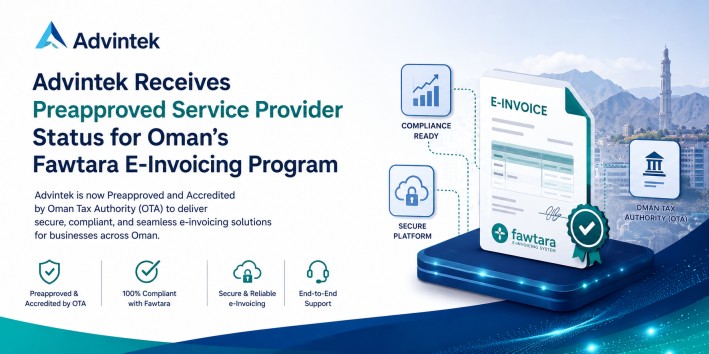
Advintek has achieved a significant milestone by obtaining the status of Preapproved Accredited Service Provider (ASP) from the Oman Tax Authority (OTA), positioning the company to assist businesses in transitioning to the country’s forthcoming Fawtara electronic invoicing system. With this designation, Advintek is empowered to offer e-invoicing solutions, automate invoice processes, and integrate with Enterprise Resource Planning (ERP) systems in preparation for Fawtara Phase 1, which is set to commence in August 2026.
The company has developed a platform aimed at helping businesses shift from traditional invoicing practices to fully compliant digital invoicing. This platform seamlessly integrates with existing ERP and accounting systems, providing features such as automated invoice processing, validation workflows, compliance monitoring, and tools for audit-ready record management and reporting. As Oman gears up for this digital transformation in invoicing, Advintek’s solutions are designed to ease the transition for organizations by ensuring they meet new regulatory standards.
To align with the Fawtara initiative, companies will need to revisit and potentially overhaul several aspects of their operations, including invoicing processes, ERP configurations, tax data management, approval workflows, and document management systems. Advintek intends to offer comprehensive support through implementation services, readiness assessments, system integration, testing, deployment, and ongoing assistance, catering to a wide array of sectors such as healthcare, manufacturing, logistics, retail, and technology.
Operating on a global scale, Advintek provides e-invoicing and digital compliance solutions in over 60 countries, supporting integrations with prominent ERP and accounting platforms like SAP, Oracle, QuickBooks, Xero, Zoho, and Sage, among others. This global presence and expertise position Advintek as a key player in facilitating the successful adoption of electronic invoicing in Oman, ensuring businesses are equipped to navigate the changes brought about by the Fawtara initiative.
Legal Disclaimer: The information contained in this article has been provided by independent third-party contributors, clients, or content partners. We do not independently verify the accuracy, completeness, legality, ownership, licensing, or reliability of submitted content, including text, images, videos, trademarks, or other media materials. The submitting party is solely responsible for ensuring that all content, including images and media assets, complies with applicable copyright, trademark, licensing, and intellectual property laws. We disclaim liability for any unauthorized use of copyrighted or proprietary materials by third parties. If you believe that any content published on this platform infringes your intellectual property rights, kindly contact the author above for prompt review and resolution.